Ongoing Improvements to Corporate Governance
- 2014
- 2016
- 2017
- 2019
- 2020
- 2021
- 2022
- 2023
- 2024
- 2025
-
President
-
2014: Appointment of Tomiya Takamatsu as president
-
-
Group
structure-
2017: Transition to holding company structure
-
2020: Formation of a Group ESG Committee(currently:Group Sustainability Committee )
-
-
Revitalizing
the Board
of
Directors
and
strengthening
its functions-
2016: Review of the scope of authority2017: Transffer of authority to group companies
-
The number of members on the Board of Directors as determined in the Artickes of Inc corporation to 9 to fewer2016: The number of members on the Board of Directors as determined in the Artickes of Inc corporation to 7 to fewer
-
2019: Formation of an Advisory Board
-
-
Improving
the
effectiveness
of the
Board of
Directors-
2017: Introduction of a performance-based incentive program2021:Formation of a Nominating and Compensation Committee
-
2016: Evaluation of the effectiveness of the Board of Directors
-
2017: Disclosure of a summary of the evaluation results
-
-
Outside
directors
(the number of people)-
2014: two of seven2016: two of six2021: three of six2022: four of seven
-
-
Outside
directors
(ratio)-
2014: 28.6%2016: 33.3%2021: 50%2022: 57.1%
-
-
Company
philosophy,
etc.-
2014: Enactment of a new group philosophy,vision,and slogan
-
2016: Enactment of a corporate governance basic policy
-
2019: Enactment of a Group Code of Conduct
-
2023: Name changed from Group Slogan to Brand Message
-
2024: Enactment of the DyDo Group Human Rights Policy
-
1. Evaluation of Effectiveness of Board of Directors
At DyDo, We have been evaluating the effectiveness of the Board of Directors since FY2016, and we adopted the following analysis/evaluation method in FY2025.
In order to analyze and evaluate the effectiveness of the Board of Directors, all directors and auditors carried out a self-evaluation survey and individual interviews between December 2025 and February 2026. After that, at a meeting of the Board of Directors, the directors analyzed the results of the self-evaluation and shared their awareness of current issues. They also held constructive discussions to plan future efforts for improving the Board's effectiveness and to realize a higher level of effectiveness for the Board of Directors.
The self-evaluation form used the following headings to review the Board's discussions and issue handling over the past year:
- (1)
Agenda and operations of the Board of Directors
- (2)
Medium- to long-term operations of the Board of Directors in light of the Group Mission 2030
- (3)
Other issues (e.g., strengthening governance structures)
Based on the analysis of the self-evaluation results of all our directors, the Board of Directors concluded that "overall, the Board of Directors is functioning appropriately, and its effectiveness is ensured."
[Improvements in the Board of Directors Operations during FY2025 and Future Challenges]
In FY2025, to identify key agenda items and promote more planned discussions, we presented the annual schedule of major topics at the beginning of the year and enhanced the Board's review of investment proposals in line with the priority theme of "executing growth investments" under the Medium‑Term Management Plan 2026. To improve returns on invested capital, we reported on the progress of initiatives using the ROIC tree at our core companies in Japan.
However, it was noted that discussions on the future direction of the business portfolio and on enhancing capital efficiency over the medium- to long-term need enhancement. Additionally, there is a need for more thorough deliberations on initiatives in the Domestic Beverage Business.
In addition, it was shared that future challenges to strengthen the functions of the Board of Directors and further enhance its effectiveness are as follows:
- (1)
To identify priority agenda items and promote more planned discussions in formulating the next Medium‑Term Management Plan
- (2)
To conduct thorough deliberations on measures to turn around the Domestic Beverage Business
2. Nominating and Compensation Committee
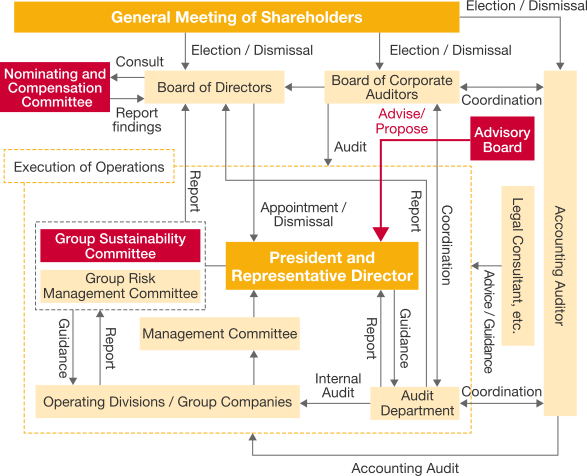
Nominating and Compensation Committee, which is being established to strengthen the independence, objectivity, and accountability with which the Board carries out its functions by empowering it to involve, and obtain advice from, independent outside directors in an appropriate manner, particularly when considering important matters such as the nomination and compensation of top management and directors.
3. Advisory Board
The Advisory Board, as a consultative body to the President, aims to further enhance the transparency of the Company's management by incorporating external perspectives into the execution of strategy, such as offering proposals on management issues faced by the Group.
4. Group Sustainability Committee
The Group Sustainability Committee, which is chaired by the president, consists of members appointed by its chairperson. It meets twice a year, and at other times as necessary, to increase the value of the Group’s corporate brand by considering and approving the Group’s overall sustainability management policy and important sustainability issues (materiality), by adopting the companywide sustainability program, and by issuing instructions for improvements.
5. Establishing an Internal Reporting Liaison Independent from Management
We have established an internal reporting liaison called the "DyDo Group Hotline," and we are working to ensure awareness about it among group employees.
If there is a violation of laws, regulations, in-house rules, or social norms, or a risk of such a violation, we ensure that the employees of our group (employees, temporary workers based on the Worker Dispatch Act, and part-timers) and employees of business partners of our group, can directly communicate that information without fear of negative repercussions.